A dining table has to do more than look composed when the room is quiet. It needs to make space for weekday dinners, children’s projects, holiday meals, and the extra guests who stay longer than planned. An extendable ceramic dining table answers that brief with a surface that feels architectural and refined, paired with the flexibility modern Canadian homes need.
For a compact Toronto condo, it can preserve valuable circulation space until friends arrive. In a larger family home, it can offer a generous setting without committing the room to its fully extended footprint every day. The best choice is not simply the largest table that fits. It is the table that feels proportionate, comfortable, and considered in both positions.
Why ceramic suits the modern dining room
Ceramic dining surfaces have become a natural fit for contemporary European interiors because they combine a clean visual language with reassuring practicality. Many designs use a slim ceramic or sintered-stone top over a supporting glass layer, creating a surface with visual lightness and substantial presence. Marble-look veining, soft concrete tones, warm stone finishes, and darker mineral shades can all bring character without the maintenance demands of natural marble.
For everyday use, ceramic is valued for its resistance to heat, scratches, stains, and fading. A hot serving dish, a glass of red wine, or an energetic family dinner is less cause for concern than it might be with a more delicate finish. That does not make the table indestructible. Avoid dropping heavy objects on edges, and use appropriate care products rather than abrasive cleaners. Still, its low-maintenance nature is a meaningful advantage for homes where the dining table is genuinely used.
The material also offers a polished alternative to high-gloss lacquer or natural wood. Wood brings warmth and can age beautifully, but it may show marks more readily and asks for more attentive care. Ceramic feels cooler and more tailored, often working especially well with upholstered dining chairs, textured rugs, timber cabinetry, and soft lighting. The result can be contemporary without feeling stark.
Choosing the right extendable ceramic dining table size
Begin with the room, not the guest count. Measure the dining area at its narrowest points, including nearby sideboards, radiators, door swings, and the route people take through the space. As a useful starting point, allow roughly 90 cm between the table edge and a wall or substantial furniture piece. Where people need to pass behind seated guests, more clearance is preferable.
Then consider the table in its closed and open dimensions. A table that is elegant for four can become a crowded obstacle when extended if the room has not been planned around its full size. This is particularly relevant in condos, where an extension may project into an open-plan living zone. There is nothing wrong with moving a chair or accent piece before hosting, but the expanded table should still feel intentional rather than improvised.
A seating allowance of about 60 cm per person is a comfortable guideline. It gives each guest enough elbow room for place settings and conversation. A 160 cm table may seat six closely, while an extension to 210 or 240 cm can make room for eight more comfortably, depending on the base design and chair width. Armchairs, generously padded seats, and sculptural shell chairs often need more space than a slim dining chair.
Table shape changes the experience as much as length. Rectangular tables are efficient in long rooms and suit larger gatherings. Round or oval ceramic tables soften circulation and can be particularly effective in condos or square dining rooms. An oval top offers the sociability of a round table while gaining the useful length of a rectangle when extended.
Do not overlook the base
The base determines where guests can actually sit. A pedestal base often provides greater freedom at the corners and ends, making it a strong choice for flexible seating. Central metal bases can also give a ceramic top a lighter, more sculptural profile. Four-leg designs may feel familiar and grounded, but check that the legs do not interfere with chairs once the table is extended.
This is one reason an in-person visit matters. Dimensions reveal capacity; sitting at the table reveals comfort. At Levida Furniture’s Markham showroom, comparing chair styles with different table bases and finishes can make a confident decision much easier.
Extension mechanisms worth understanding
Not all extension systems create the same visual result or daily experience. The right option depends on how frequently you host, how much storage you have, and whether you prefer the leaf to remain attached to the table.
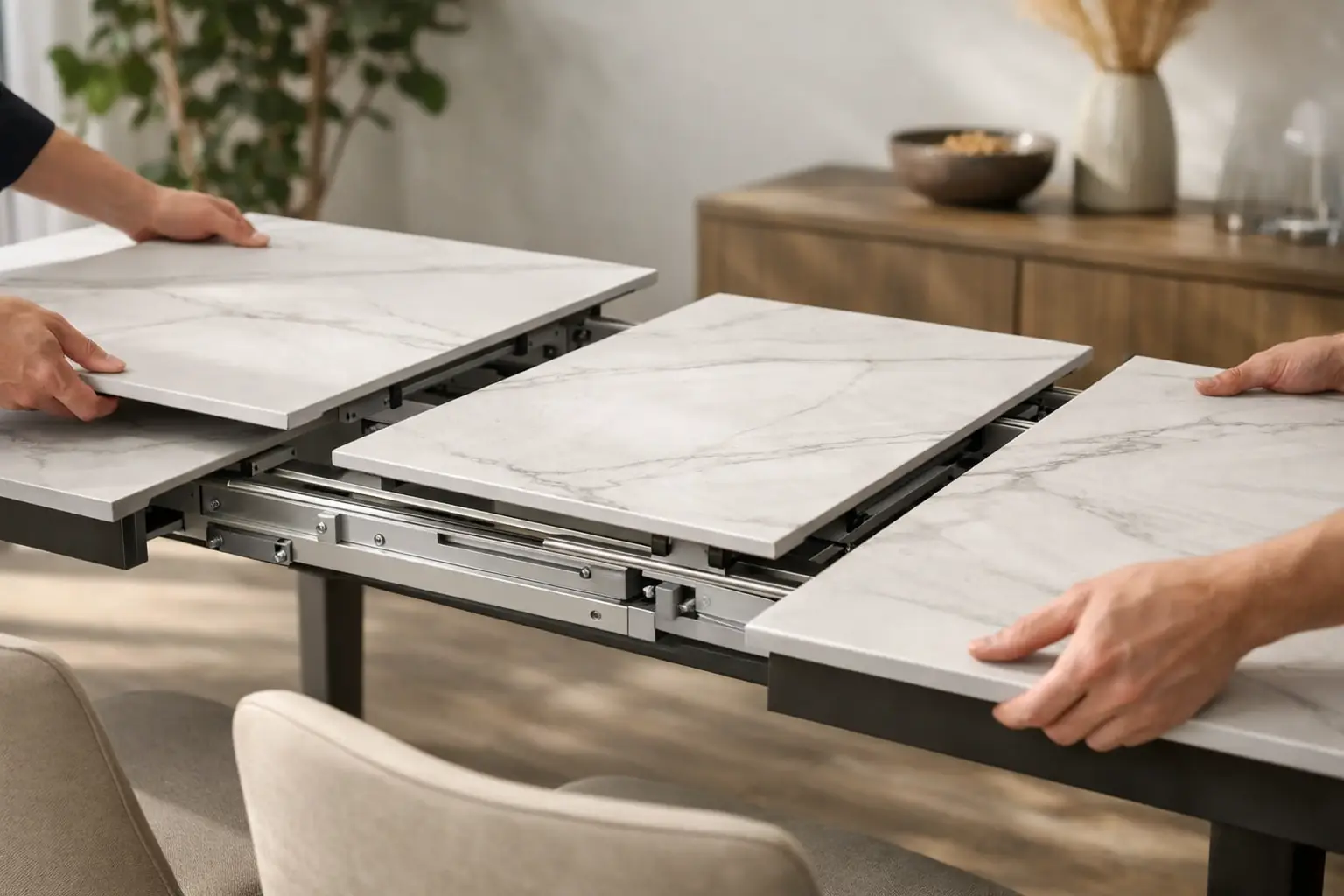
A butterfly extension is stored within the table and unfolds from the centre as the top opens. It is convenient for regular entertaining because the leaf is always available. Quality matters here: the mechanism should feel balanced, move smoothly, and close precisely so the tabletop remains level.
A manual centre extension uses a separate leaf, usually stored elsewhere when not required. This can allow a very clean, slim closed table, but it asks you to keep the leaf protected and accessible. It is a sensible choice if you extend the table mainly for holidays or occasional dinner parties.
Some European designs use end extensions or synchronized opening systems. These can be exceptionally practical, particularly on larger tables, but it is worth seeing how the top moves and where the joins fall. With a patterned ceramic surface, alignment should look deliberate rather than distracting. A good design treats the extension as part of the table, not an afterthought.
Before choosing, open and close the mechanism yourself. Consider whether one person can manage it, whether the table needs to be pulled away from a wall first, and whether your flooring can accommodate the movement. A beautifully engineered extension should feel calm and intuitive, not like a task reserved for special occasions.
Matching finish, chairs, and the rest of the room
Ceramic gives you considerable freedom, but its finish should relate to the wider interior. Pale stone or travertine-inspired tops can brighten a room with walnut, oak, or black detailing. Charcoal and deep grey ceramics create drama alongside cream bouclé, cognac leather, or warm-toned upholstery. A white marble-effect top can feel striking, though a warmer off-white often sits more naturally with Canadian light and layered neutral interiors.
Look at undertones rather than colour alone. A grey ceramic may lean blue, green, or taupe. A black base may be crisp matte black, softened graphite, or warm bronze. These distinctions are subtle in a showroom and much more obvious once the table is surrounded by flooring, cabinetry, and daylight at home.
Dining chairs should provide contrast in texture or form. A sleek ceramic table paired with equally hard, angular chairs can feel overly formal. Upholstered chairs introduce comfort and acoustic softness, while curved backs balance the linear geometry of a rectangular top. If the table will host longer dinners, sit for more than a moment. Back support, seat depth, and arm height matter as much as the silhouette.
For an open-concept home, treat the table as part of a larger composition. Repeat a metal finish from the living room lighting or console, echo a warm fabric from the sofa in the dining chairs, or choose a ceramic tone that connects with the kitchen island. Cohesion does not mean every piece must match. It means the materials appear to be in conversation.
Care that preserves the finish
Daily care is straightforward: wipe spills with a soft cloth, warm water, and a mild pH-neutral cleaner. Dry the surface afterward to avoid streaking, particularly on darker matte finishes. Avoid steel wool, highly abrasive pads, and harsh chemical products, which can affect joints, frames, or the finish around the tabletop even when the ceramic itself is highly durable.
Pay attention to the moving parts as well. Keep crumbs and debris out of the extension tracks, and operate the table evenly rather than forcing one side. If a table has an integrated leaf, close it carefully so nothing catches beneath the mechanism. These small habits help retain the effortless action that makes an extendable design so appealing.
The right table should make a room feel ready rather than overly arranged. Choose a ceramic finish you will enjoy on an ordinary Tuesday, then make sure its extension gives you room for the people you hope to welcome on a Saturday night.